

Why Annotation Is Important for Literacy
Annotation is about making reading an active process, not just creating a busy, colorful page.

As teachers, we often ask students whether they understood what they read. Whether they did or not, a student can finish a five-page passage and tell you, “I understood it.” We can give a quick reading quiz to make sure, but we don’t always give them a way to show the thinking that happened while they were reading. What happened along the way as they read?
Annotation is about making reading an active process, not just creating a busy, colorful page. It also doesn’t have to be complicated. When students underline, question, connect, summarize, and respond to a text, they make their comprehension visible, making annotation a powerful tool for developing independent, analytical readers.
Annotation Turns Students into Active Readers
Reading comprehension happens largely inside a student’s head, which makes it difficult for teachers to track. Annotation gives teachers a window into that process. A student’s notes can reveal misunderstanding, curiosity, inference, and interest in what they’re reading. It shows which important details students are picking up, and what they’re skipping over. It also encourages students to reread so they can review their notes, reassess their earlier interpretations, and develop stronger analysis.
Annotation also gives students a reason to interact with the text rather than just read through it. The goal is for students to notice more while reading and mark what they notice. When students pause to summarize, question, clarify, and connect ideas, they’re practicing the processes involved in comprehension, helping them recognize that comprehension isn’t something that happens automatically at the end of reading.
Annotation gives students a record of their thinking, allowing them to see how and if their interpretations change. For example, a student might initially write, “This character is angry.” However, after reading further, they realize, “Actually, he seems angry because he’s embarrassed.” It teaches students that good readers can change their minds, and that adjusting and being more detailed in their analysis is an important step in literacy.
Annotation Builds the Foundation for Analytical Writing
Analytical essays can be an intimidating step for any ELA class. However, annotation gives students a series of notes from their reading that shows how they went from understanding to interpreting to analyzing. It provides an intermediate step to analysis, rather than asking students to immediately write analytically.
For instance, if a student marks all the times an author uses words related to darkness, they can then easily note the correlation between darkness and the character’s growing isolation. This means that when the student approaches an analytical paragraph, the work of “what” connection the author was trying to make is already done. The student can focus more attention on explaining “how” the author achieved it. Annotation actually makes the writing process easier and less daunting.
Not All Annotation Is Created Equal
Examples of annotation, the color-coded, note-filled pages, can often seem almost like a foreign language when students encounter it for the first time. Without a proper introduction to annotation, teachers might just receive a wall of highlighted paragraphs with the note “important” beside it. The issue isn’t that students don’t know what annotation is. Rather, they haven’t been taught what is worth noticing and noting.
The key is to teach annotation as a set of purposeful reading behaviors. Like anything, annotation requires a slow building of mental muscles to have it be an effective tool. Beginners in annotation will require some direction. Instead of asking students to just “highlight important information,” provide more detailed instructions for a first attempt. Students are much more likely to annotate meaningfully when the annotation has a purpose.
Before reading, try giving students a lens through which to annotate: “Today, we’re tracking how the author’s word choice changes the tone,” or “As you read, mark moments when the character’s understanding of the situation changes.” As students become more proficient, they can be asked to notice patterns, author’s choices, character motivations, syntax, and more. Soon, they’ll start noticing these details themselves as the habit builds. Emphasize that the goal is annotations that demonstrate how they thought about the story.
When students annotate, the text stops being something they need to quickly comprehend, but rather, something they question, challenge, connect to, and return to. What often seems like an optional, small instructional tool, can actually be the key to seeing how your students understand what they’re reading and how they’re writing about it. Annotation teaches students that reading isn’t just about finishing a text; it’s having something to say when you get there.
If you want to introduce or reinforce annotation in your classroom this year, we have a free lesson plan to practice rereading, annotating, and reevaluating how students comprehend and analyze the poem “Neutral Tones,” by Thomas Hardy.
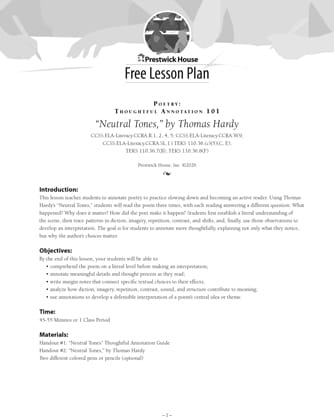
Free Lesson Plan: Thoughtful Annotation 101
This free activity will help you show students the basics of productive annotation using the poem “Neutral Tones,” by Thomas Hardy. Your students will learn how to annotate reading passages more thoughtfully, explaining not only what they notice, but why the author’s choices matter.