3 Benefits of Pairing Informational Texts with Novels
Pairing nonfiction texts with literature can help your students become better readers of fiction.

You’re a few chapters into a novel when you realize your students are missing something important. Maybe they don’t know enough about the time period. Maybe an allusion goes right over their heads. Or maybe the book is raising questions about the real world that deserve more discussion.
That’s a good time to bring in an informational text.
Articles, essays, speeches, primary sources, and other nonfiction texts can give students useful context and another perspective on what they’re reading. They can also help students make connections between the ideas in literature and the world around them.
Here are three ways informational texts can add to the novels you already teach.
Informational texts give students essential context.
Some works of literary fiction are full of allusions. Historical events, political movements, mythology, cultural references, and other allusions can all influence how much a reader understands.
If the book your students are reading has a glossary that explains these allusions, that’s great! In some cases, though, you might want to give your students more information so that they better understand why the author included a certain allusion. The author may have alluded to a very dense topic, and one or two paragraphs might not tell the whole story. That’s where nonfiction texts come in.
An article, primary source, biography, or historical document can give students the background they need before or during a novel without requiring you to turn your literature class into a history lecture.
The goal isn’t to explain everything before students encounter it. It’s to give them enough information to recognize what matters and make stronger connections when they return to the literature.
Informational texts help students understand current issues.
In some ways, our modern world is very different from the world that existed even half a century ago—you need only take a look at the internet to see maybe the most profound change. And yet, literature was dealing with internet-era issues long before the internet was in place.
For example, think about a major issue that has been in the news over the last decade: constant government surveillance via the internet. Governments are using the internet to spy on one another as well as their own citizens.
Well, George Orwell examined a government’s surveillance of its own citizens way back in 1949, when he wrote 1984. Philip K. Dick’s Do Androids Dream of Electric Sheep? examined how government surveillance could be used to target minorities. And Kafka wrote about the horrors that complicated bureaucracies visit upon individuals simply by the power of their overwhelming size and complexity.
Reading news reports and essays about data tracking through smartphones, apps, and social media is a pretty good way for students to connect the events depicted in 1984, Do Androids Dream of Electric Sheep?, and several of Kafka’s works to current issues of government surveillance. Students can use the combination of nonfiction and literary texts to come to their own conclusions.
This sort of synergy between informational text and literature isn’t rare!
If you look carefully, you can find plenty of nonfiction texts that will help students connect the dots between literature and real life, helping them understand that great works of literature are more than just stories—they’re reflections of our shared experiences.
Informational texts help students learn to question everything.
Although nonfiction texts (usually) aren’t full of things authors make up, we shouldn’t regard them as 100% objective truth, either. This can be a hard concept for students to wrap their heads around, but nearly every nonfiction text ever created has some sort of slant, spin, and/or bias that was introduced by the author, whether intentionally or not.
How will understanding this help students become better readers of fiction?
Well, literature is full of characters who, while they might not blatantly lie to other characters, might not tell the whole truth. They might frame some events so as to make themselves look better to other characters in hopes of influencing those characters. Students who can detect slant, spin, and bias in nonfiction can use those skills to detect subtext and subtle meanings authors create through word choice in literary texts.
Pairing with a purpose.
Pairing a novel with informational texts doesn’t mean giving students more reading simply for the sake of it. The best pairings have a purpose.
Sometimes students need historical context before a chapter will make sense. Sometimes a contemporary article can turn an abstract theme into something they recognize. And sometimes comparing two very different texts gives students a reason to look more closely at how each author presents an idea.
A novel can still remain at the center of the lesson. Informational texts simply give students more knowledge, perspectives, and questions to bring with them when they open the book again.
(By the way, we have a great little book on slant, spin, and bias. Check it out if you're looking to teach students the skills they need to identify it in nonfiction.)
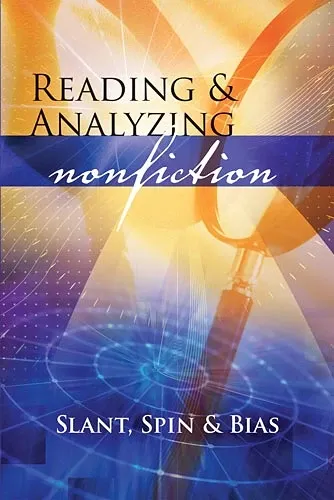
Reading & Analyzing Nonfiction: Slant, Spin, & Bias
Nonfiction is never completely objective. Teach your students the critical thinking skills they need to evaluate nonfiction texts with Reading & Analyzing Nonfiction: Slant, Spin & Bias.
Students will read and analyze rigorous historical and contemporary texts like the Declaration of Independence and Pulitzer Prize-winning editorials. Exercises and writing assignments will help students learn to recognize biased writing and avoid falling for flimsy arguments.