
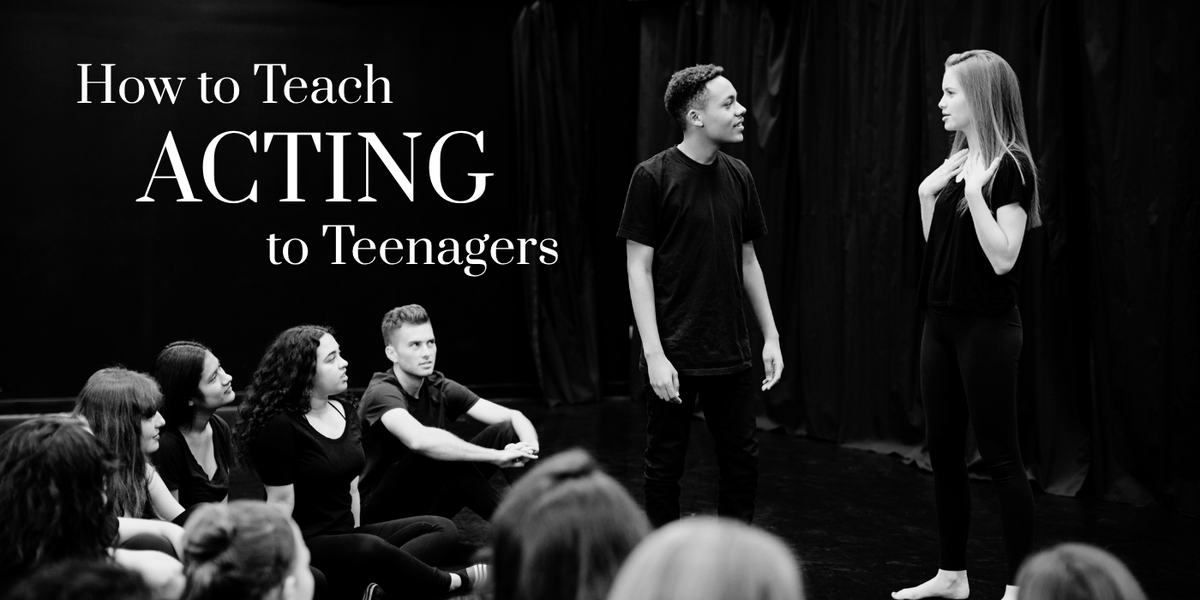
How to Teach Acting to Teenagers
In this guest post by Samantha Marsden, discover four proven ways to enhance any acting class for children and teens, plus find two practical exercises you can do in your own classroom.

When I was a teenager, I was desperate to know what was being taught behind the doors of the professional drama schools. So when I became a drama teacher, that’s what I taught, and my classes filled up with waiting lists.
What I learned over eleven years of full-time teaching is that children and teenagers love learning real acting techniques. They can tell when they’re being taken seriously, and they rise to meet it. Here is how to do it.
1. Create a safe space before you teach anything.
Nothing else works without this. Children and teenagers will improvise, perform, and take creative risks only if they know they won’t be laughed at for failing. Lay down your rules early (mine are kindness and good listening), and never tolerate mocking, negative remarks, or talking over someone’s performance. Make it clear that anyone is allowed to sit out and watch at any point; never force a student to take part. Most importantly, encourage mistakes. Celebrate them, even. Ask students to leave their inner critics at the door, and end every performance, however wobbly, with applause and praise for its strong points.
2. Teach the real thing, but hide the theory inside a game.
Teenagers don’t want a watered-down version of drama, and they don’t want a lecture either. The trick is to teach genuine drama-school technique, given circumstances, objectives, and actions through games, so that students absorb the theory by doing it.
The two exercises below, both from my book, are a perfect pair to start with. The first teaches given circumstances, a term coined by Stanislavsky for a character’s situation: who they are, where they are, what has just happened, and what is at stake. The second teaches actions: what a character does to get what they want. Between them, they cover two of the most taught ideas in actor training.
Taxi Driver with Given Circumstances
From 100 Acting Exercises for 8–18 Year Olds, by Samantha Marsden
A fun improvisation game in which students play out a scene in a taxi
Ages: Eight and up
Skills: Communicative skills, intuition, listening, spontaneity, creating a character, and imagination
Participants: Minimum of two students; it can be practiced as a group too.
Time: 10–20 minutes
You’ll need: Five chairs set out in the shape of a car
How to: Set up five chairs—two as the front seats of a car and three as the back seats. Ask the class to sit down in front of the imaginary car as an audience. Ask two students who are happy to improvise to volunteer. One student will be the taxi driver, and the other will hail the taxi and get into the car.
Ask the students to create a character by developing a set of given circumstances. For example, the taxi driver’s given circumstances might be that they are at the end of a long shift, they have taken on extra hours to fund their son’s university tuition, and they are exhausted. The given circumstances of the person who is getting into the taxi might be that they have an audition at the other end of town, they are really hoping to get the part, as it’s for their favorite musical of all time, and they need to warm up their voice. Students can choose any given circumstances they like; three is a pretty good number to start off with.
Once they have their given circumstances, let them improvise the scene. When the improvisation looks as if it’s drawing to a close, initiate an applause, praise the good points of the improvisation, and ask two more students to come up on stage and have a go. You can also ask students to go off and work in pairs if they feel too shy to perform.
Tip: Explain/demonstrate that it’s important to really imagine the car. If you’re the person getting into the taxi, imagine opening the car door and putting on a seatbelt. If you’re playing the taxi driver, steer, use a gear stick and hand brake, and keep your eyes on the road.
Shaking Hands with Actions
From 100 Acting Exercises for 8–18 Year Olds, by Samantha Marsden
A fun warm-up in which students shake hands and introduce themselves while playing actions
Ages: Eight and up
Skills: Social skills, improvisation, and awareness
Participants: A group of five or more
Time: 5–10 minutes
You’ll need: A room big enough for students to stand in two long lines facing one another
How to: Students get into pairs and stand opposite one another, forming two lines with about eight steps between them. One partner is designated A and the other B. You call out an action for each line—for example, “accept” for A and “bully” for B—and then the partners will walk toward each other, shake hands, and introduce themselves, all while playing their actions. There will be a whole fabric of subtext that the students will play without much prompting. Do this eight or nine times, changing the actions for both students each time.
Here are some examples of actions you can use. Accept, Accuse, Adore, Annoy, Badger, Beg, Bewitch, Bully, Calm, Challenge, Confront, Dazzle, Deflate, Defy, Enchant, Enrage, Flatter, Hush, Ignite, Indulge, Inform, Insult, Offend, Persuade, Pester, Petrify, Praise, Quiz, Refuse, Reject, Relieve, Repel, Rescue, Sadden, Shame, Silence, Tease, Thank, Tolerate, Upset, Urge, Validate, Weaken, Welcome, and Worship.
Variation: Instead of shaking hands, have the pairs do an activity together, such as playing tennis, building a sandcastle, or baking a cake. Call out actions for them to perform while they play the chosen activity.
Tip: Start with simple actions everyone is familiar with, such as adore, bully, flatter, and judge. Move on to harder actions later, and explain the meaning of each unfamiliar word to the class. Harder actions might include pacify, repel, validate, and lull. Explain to students that it’s always okay to ask what a word means—chances are that there are other people in the group who don’t know either.
3. Structure the lesson so it builds.
A good acting lesson has a shape. I aim to spend the first third of a session on relaxation, voice work, and games; the second third on more advanced acting exercises like the two above; and the final third working toward a short piece, a polished improvisation or a scripted scene, that is performed at the end of the session, even if only for the rest of the class. That little performance at the end of every lesson is great for confidence-building: Performing in front of others stops being a special, terrifying event and becomes something students do every week.
Vary your material, too. I don’t recommend building a whole lesson around a single technique. For a well-balanced hour, choose four to seven exercises drawn from three or four different areas: one relaxation exercise, one voice exercise, a game to unblock nerves, and then your main technique work. Students stay engaged when the pace keeps changing.
4. Level it up as they grow.
The beauty of teaching technique through games is that the same game can grow with your students. Once a class is comfortable with Taxi Driver, add a layer: Have each actor play an objective (something their character wants from the scene) on top of their given circumstances. Later, add actions, too: Is the passenger charming the driver, or needling them? Advanced students can play given circumstances, objectives, and actions all at once.
And always end by asking the class what they liked, what they didn’t, and what they learned. Students are brilliant, honest evaluators, and a teacher who listens is one who is a part of the safe space that makes growth possible.
100 Acting Exercises for 8–18 Year Olds moves through eleven chapters: Relaxation and Focus, Voice, Movement, Unblocking Performers, Given Circumstances, Objectives, Actions, Imagination, Physicalizing Characters, Creating a Believable Performance, and Bringing the Text to Life. The book takes young actors from warming up body and mind through to professional character-building techniques and performing text, with sample lesson plans to tie it all together.
Samantha Marsden taught drama full time for eleven years and now teaches a little alongside her writing. She is the author of 100 Acting Exercises for 8–18 Year Olds, Acting Games for Improv, Drama Games for Early Years, Acting Exercises for Creative Writing, Drama Games for Mindfulness and Emotional Health, and Focus Games for the Classroom.