
Helping At-Risk Students Read Rigorous Texts
Challenging texts don’t have to be out of reach for struggling readers. Discover practical ways to give students the support they need without lowering expectations.

One of the toughest tasks you’ll ever face is teaching challenging texts to at-risk students, who, for whatever reason, are reading below grade level. Reading can be frustrating for these students; they just don’t have the tools they need to tackle the books you’ve assigned.
They can develop these tools with the proper support. By no means is this an easy process, and you might not succeed with every student—there are too many variables at play, some of which you can’t control. But what happens in the classroom is something you can (mostly) control. Sometimes it’s tough to stay positive, but you can help these students.
Here are a few things to try.
Keep Expectations High
One of the dangers of teaching at-risk students is that we can fall into the trap of expecting them to achieve at a lower level simply because they’ve been designated “at-risk.” And if you’re starting the year with a classroom full of students reading below grade level, you can give them the confidence they need to meet the challenge. The following techniques can help.
Use Judicious Scaffolding
One way to help your students achieve success is scaffolding. When you’re trying to get your students to read rigorous texts, this scaffolding can take many forms:
- Inline annotations. Annotations are good for a number of things. They can give students the definitions of unfamiliar vocabulary words. They can help students parse tough passages, possibly by interpreting these passages in simpler language. They can point out premises (both explicit and implicit) of formal arguments.
- Pre-reading lessons. Before your students start reading, prime them with information. Does the book have an unconventional structure? Does it use unconventional or odd sentence structures (like most Shakespeare)? Show students what these structures look like and teach them how to read them. Do students need any specific background knowledge to better understand the text? Provide that information in advance.
- Exercises throughout the text. Make plot outlines for each chapter and fill in some events but have students fill in the others. In later chapters, leave out more events so students have to fill in more information. Or, show them news articles, videos, chapters from other books, etc., that connect to the text. Ask them to write about their own experiences and how they relate to the book. These activities will help students engage with the book's ideas.
Creating extra support for your at-risk students can be time-consuming. We can help with teaching resources that save you time and effort.
Our Literature Teaching Guides offer different ways to help students work through challenging books. Depending on the title, you might use an Activity Pack to give students more hands-on ways to explore the text, a Response Journal to get them writing and thinking about what they’ve read, or other teaching guides that provide questions, activities, and instructional support throughout the book.
Choose the resources that make sense for your students, and adjust the amount of support as their reading skills and confidence grow.
Use Direct Vocabulary Instruction
If you teach in a school where some children come from disadvantaged economic backgrounds, you may be facing an additional challenge. Research suggests that these students will enter school with less-developed vocabularies than children from wealthier households, and this gap only grows as children advance through school.
Direct vocabulary instruction can help close the gap. As with any course of direct vocabulary instruction, you’ll want to focus on Tier 2 words, though some students may need some instruction with Tier 1 words as well.
Give students several different ways to learn the words to help them stick. You may want to try:
- short story writing
- drawing pictures
- paired conversation (for oral practice)
- using context clues in reading passages to decipher meaning
If you want to make direct vocabulary instruction a regular part of your curriculum, Vocabulary Power Plus provides a structured way to give students repeated practice with high-impact words. Rather than having students memorize a list of definitions, the program introduces vocabulary through a variety of exercises that ask students to work with words in context and apply what they’ve learned. For struggling readers in particular, that repeated exposure can help unfamiliar words become less intimidating when they encounter them in a new text.
Making Challenging Texts Feel Possible
Teaching challenging texts to struggling readers takes patience, and progress won’t always be obvious. For some students, finishing a difficult chapter is an accomplishment. For others, it’s recognizing a word they learned last week or making sense of a passage that would have stopped them before.
Those moments matter. Each one gives students a little more experience and confidence for the next difficult text they encounter.
You can’t remove every obstacle your students face, nor should you remove every challenge from their reading. But you can help them discover that a difficult text isn’t necessarily an impossible one. Sometimes, getting students to believe that is an important first step.
Reading Resources
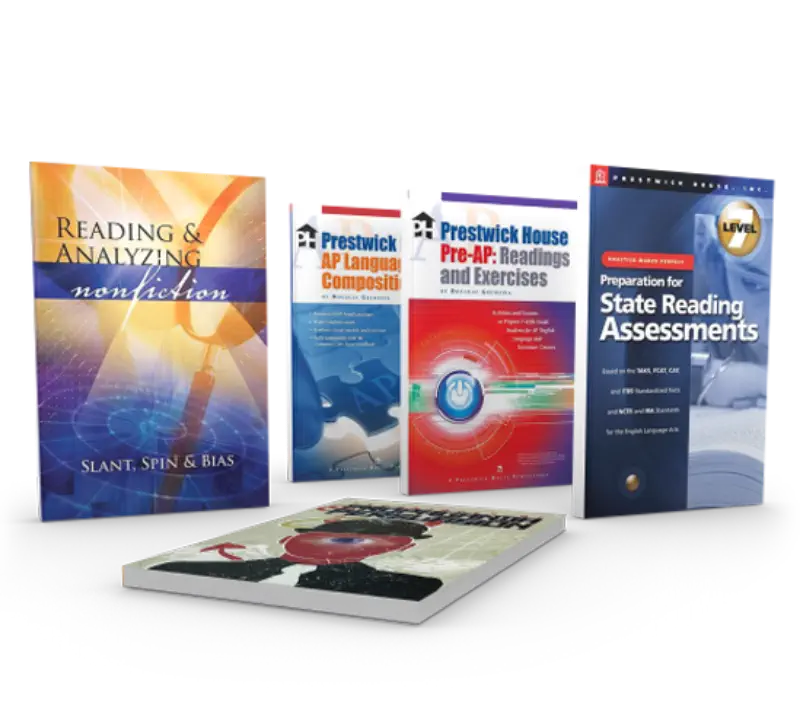
With Prestwick House reading programs, your students will engage in active learning, using both fiction and nonfiction, to improve their reading comprehension.