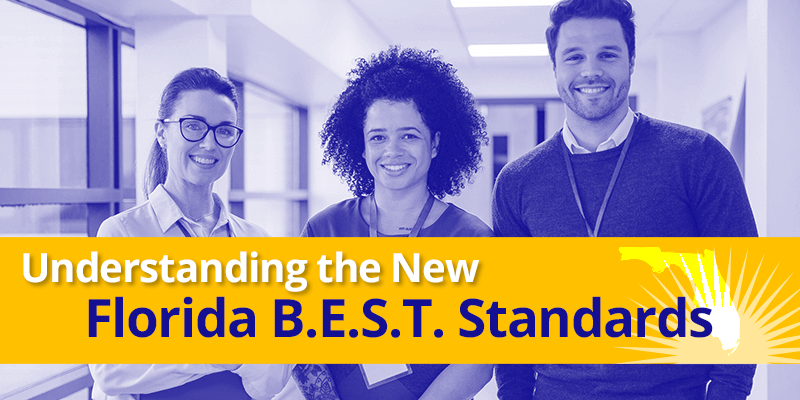
Understanding the New Florida B.E.S.T. Standards
Curriculum changes are coming to Florida’s public schools. How will the new B.E.S.T. Standards affect English language arts education in grades K-12?

It’s official: Florida is moving away from the Common Core State Standards.
On February 12, 2020, the state’s Department of Education adopted the Florida Benchmarks for Excellent Student Thinking (B.E.S.T.) Standards, a new system for measuring student development. These rigorous standards, which heavily focus on mathematics and English language arts skills, are designed to prepare students for success in college and beyond.
Florida’s Department of Education plans to roll out the B.E.S.T. Standards across public schools in stages, beginning with professional development for teachers in the 2020-2021 school year. By 2023, the state hopes to adopt the standards in full.
How will these changes affect the English language arts curriculum in Florida’s public schools? Let’s take a closer look!
The Florida B.E.S.T. Standards for English Language Arts
At its core, the Florida B.E.S.T. Standards for English Language Arts (ELA) are intended to promote literacy by prioritizing the basics of reading and writing. They were built on the following premises:
- English language arts is not a discrete set of skills, but a rich discipline with meaningful, significant content, the knowledge of which helps all students actively and fully participate in our society.
- The standards are clear and concise so they are easily understood by all stakeholders, including parents and teachers.
- The texts students read are meaningful and thought-provoking, preparing them to be informed, civic-minded members of their community.
- Standards should not stand alone as a separate focus for instruction, but should be combined purposefully.
There are six expectations that are embedded within the standards. These are the overarching skills that students are expected to develop over the course of their ELA education:
| ELA.K12.EE.1.1 | Cite evidence to explain and justify reasoning |
| ELA.K12.EE.2.1 | Read and comprehend grade-level complex texts proficiently |
| ELA.K12.EE.3.1 | Make inferences to support comprehension |
| ELA.K12.EE.4.1 | Use appropriate collaborative techniques and active listening skills when engaging in discussions in a variety of situations |
| ELA.K12.EE.5.1 | Use the accepted rules governing a specific format to create quality work |
| ELA.K12.EE.6.1 | Use appropriate voice and tone when speaking or writing |
The mastery standards represent the skills students should master by the end of each grade. They are divided into four strands: Foundations, Reading, Communication, and Vocabulary.
| Foundations | This strand has been adapted to meet the needs of the traditional beginning reader and expanded to include remediation for secondary students who are not yet proficient readers. |
| Reading | This strand is divided into three standards: reading prose and poetry, reading informational text, and reading across genres. |
| Communication | This strand is divided into five standards: communicating through writing, communicating orally, following conventions, researching, and creating and collaborating. |
| Vocabulary | This strand consists of one standard: finding meaning. Vocabulary is a building block of knowledge and essential to a thorough understanding of a text. |
To build proficiency, students will continue to review and apply earlier grade-level benchmarks and expectations throughout their academic careers. If any skills aren’t mastered, students will be given instruction and practice opportunities to address skill gaps from previous grades.
Key English Language Arts Curriculum Changes
Incorporating Morphology into Vocabulary Study
Beginning in 3rd grade, students are now expected to identify and apply knowledge of common Greek and Latin roots alongside base words and affixes to determine the meaning of unfamiliar words. These skills are further developed in 9th grade, where students are asked to use their understanding of etymology and derivations to decipher the meanings of words and phrases.
Our etymology-based vocabulary programs, Growing Your Vocabulary for grades 4-6 and Vocabulary from Latin and Greek Roots for grades 7-12, have what you need to strengthen your students’ knowledge of word roots. Free sample pages are available for each program.
Introducing Rhetoric in 6th Grade
Previously, under the Common Core State Standards, students were introduced to rhetoric in 9th grade. Now, students will learn about rhetoric starting in 6th grade. This change was made to promote students’ understanding of argumentative language, reasoning, and debate earlier in their education career.
To help your students meet these new rhetoric expectations, we recommend two of our writing programs, Rhetorical Devices and Rhetoric, Logic, & Argumentation. You can download free sample pages for each program on their corresponding pages.
Replacing State Tests with the SAT or ACT
The Florida B.E.S.T. Standards mandate that most state standardized tests in the secondary grades will be replaced with the SAT and/or the ACT. In addition, taking the SAT or ACT will now become a high school graduation requirement, although students do not need to receive a passing grade to graduate. Students in 11th grade will be eligible to take the tests for free.
To help your students prepare for this new test day, why not give SAT Power Prep a try? Designed specifically for English classrooms, this complete course comes loaded with resources, including SAT-style reading passages and questions designed to familiarize students with the formatting of the test. You can find free sample pages here.
Embed Civic Literacy in English Language Arts
To help students develop into civically engaged and well-informed adults, civics are now a major part of the ELA curriculum under the B.E.S.T. Standards. Throughout their academic career, students are required to study important historical texts, including foundational American documents like the United States Constitution and the Declaration of Independence.
Here are a few of the recommended civic literacy selections for grades 6-12:
Civics Grades 6-8
- A Kids’ Guide to America’s Bill of Rights
- Alexander Hamilton: The Outsider
- Lincoln: A Photobiography
- The Words We Live By: Your Annotated Guide to the Constitution
Civics Grades 9-12
- The Autobiography of Benjamin Franklin
- Transcendentalism
- Common Sense
- Democracy in America
- Federalist Papers
- Out of Order: Stories from the History of the Supreme Court
- The Republic
For further civics study, consider adding Essential American Documents and Speeches: Volume One and Essential American Documents and Speeches: Volume Two to your classroom library. Each of these paperbacks contains significant nonfiction texts that represent the breadth of American philosophy from the nation’s founding to the present day. Free sample pages are available for both volumes.
ELA Resources for the Florida B.E.S.T. Standards
At Prestwick House, we’re ready to help Florida schools take learning to new heights! Visit our portal for Florida teachers to find exclusive resources that complement the Florida B.E.S.T. Standards for English language arts, including special standards-aligned Classroom Library Packs for grades 4-12.
Established Reading Lists for Grades K-12
While teachers can still select from books that they love to teach, the state has provided a list of recommendations chosen to align with the reading expectations of each strand at each grade level. These suggested texts come from many literary periods and cover a host of genres, including classic literature, folktales, poetry, essays, speeches, satire, memoirs, and plays.
Here are a few of the recommended reading selections for grades 7-12:
7th Grade
- Freedom Walkers: The Story of the Montgomery Bus Boycott
- George vs. George: The American Revolution As Seen from Both Sides
- Old Yeller
- The Adventures of Tom Sawyer
- The Count of Monte Cristo
- The Kon-Tiki Expedition
- Narrative of the Life of Frederick Douglass
- The Prince and the Pauper
- The Twenty-One Balloons
- The Red Umbrella
8th Grade
- The Gift of the Magi
- Anne Frank: The Diary of a Young Girl
- Long Walk to Freedom
- I Will Always Write Back
- Dr. Jekyll and Mr. Hyde
- Things Fall Apart
- Team Moon: How 400,000 People Landed Apollo 11 on the Moon
- The Call of the Wild
- The Hobbit
- To Kill a Mockingbird
9th Grade
- 1984
- Animal Farm
- Antigone
- Beowulf
- Finding Mañana: A Memoir of a Cuban Exodus
- Romeo and Juliet
- The Hero with a Thousand Faces
- Unbroken
- The Odyssey
- The Prince
10th Grade
- A Raisin in the Sun
- A Tale of Two Cities
- The Crucible
- Cry, the Beloved Country
- Fahrenheit 451
- Frankenstein
- Lord of the Flies
- Macbeth
- A Midsummer Night’s Dream
- Of Mice and Men
11th Grade
- The Canterbury Tales
- Jane Eyre
- Julius Caesar
- Night
- One Day in the Life of Ivan Denisovich
- The Dreamer
- The Surrender Tree: Poems of Cuba’s Struggle for Freedom
- Walden
- Billy Budd
- The Inferno
12th Grade
- Crime and Punishment
- Flatland: A Romance of Many Dimensions
- Hamlet
- Heart of Darkness
- Longitude: The True Story of a Lone Genius Who Solved the Greatest Scientific Problem of His Time
- Pride and Prejudice
- Rosencrantz and Guildenstern Are Dead
- The Republic
- Utopia
- Don Quixote
You can view the entire reading sample list for grades K-12 within the B.E.S.T. Standards: English Language Arts document.
Get the Details
To learn all about the new Florida B.E.S.T. Standards, check out the following links to the Florida Department of Education’s Standards portal:
- Standards Review
- B.E.S.T. Standards Fast Facts
- B.E.S.T. Standards: English Language Arts
- Civic Literacy
If you’re looking for ELA programs and materials that align with the new B.E.S.T. Standards, please reach out to us at Prestwick House by calling our customer service team at 1-800-932-4593 or by sending an email to info@prestwickhouse.com. As always, we’re happy to help you!