10 Successful Literature Pairings (Modern Books and Classic Works)
Pairing modern books with classic works helps you bridge the gap between required reading that’s not always fun and fun reading that’s not always required.

Teaching classic literature is essential in the English classroom, but sometimes, students struggle connecting to texts from different eras. Pairing modern books with classic works helps you bridge the gap between required reading that’s not always fun and fun reading that’s not always required.
Check out this list of book pairings that includes many of the books you’re already teaching this year!

10. Night and Maus
In Night, Wiesel unveils his terrifying, unforgettable experiences in German concentration camps. His memoir, easily one of the most important books ever written about the Holocaust, would pair well with Art Spiegelman’s award-winning graphic novel, Maus. Central to both these vital reads is the strong bond between a father and his son and the unspeakable realities of the Holocaust. Order Night Order Maus

9. 1984 and Feed
1984 is an easy choice for a dystopian literature unit, and its themes of surveillance, language, and consumerism also play a large role in Feed. Pair Feed with 1984 and encourage your students draw comparisons between the two novels, especially the views each author expresses on government intrusion and censorship. Order 1984 Order Feed

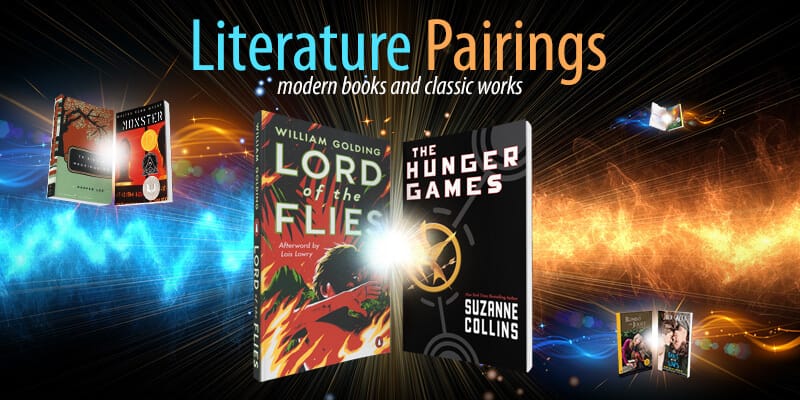
8. Lord of the Flies and The Hunger Games
Would The Hunger Games even exist without Lord of the Flies? Suzanne Collins pays tribute to William Golding’s classic 1954 novel in her young adult bestseller. Both books present ideas about humanity, privilege, and survival. Spark exciting discussion by asking your students which environment they would be more afraid of—the island in Lord of the Flies or The Hunger Games arena? Order Lord of the Flies Order The Hunger Games

7. To Kill a Mockingbird and Monster
To Kill a Mockingbird is quintessential classic literature that focuses on complex themes of racism and injustice. Prepare your students for this heavy subject matter with Monster, a YA novel that presents similar ideas about prejudice and the law and boasts an approachable format of flashbacks and epistolary content. As you teach Monster and Mockingbird, your students will be fascinated comparing these court proceedings; for example, both novels feature a black defendant and a white lawyer, but the trials shake out quite differently from each other. Order To Kill a Mockingbird Order Monster

6. Fahrenheit 451 and The Last Book in the Universe
Could a book ever be proclaimed as Fahrenheit 451’s sequel? If so, it would be none other than The Last Book in the Universe. Set in a dystopian future in which books—and their ideas—have been destroyed, Philbrick’s young adult sci-fi novel is the perfect choice to pair with Bradbury’s classic. Both novels emphasize the cruciality of knowledge, preservation, and rebellion in the face of corruption. Order Fahrenheit 451 Order The Last Book in the Universe

5. Romeo and Juliet and The Fault in Our Stars
Just like the titular characters in Shakespeare’s play, Hazel and Augustus are star-crossed teenagers in John Green’s heartbreaking novel; however, instead of warring families, it’s cancer that threatens to drive these two apart. Both couples move forward, despite the odds. If you decide to use this novel pairing in your classroom, be sure to have several boxes of tissues on-hand. Order Romeo and Juliet Order The Fault in Our Stars

4. The Diary of Anne Frank and The Book Thief
Both of these titles, essential to a unit on the Holocaust, feature a young protagonist wise beyond her years. Students will undoubtedly be drawn in by two unique, intimate perspectives—Anne, a Jewish teenager and aspiring writer, unfairly taken from the world, and the story of Liesel “the Book Thief,” told by Death itself. Though Anne Frank was a real person and Liesel Meminger a work of fiction, they both wield the power of words to express fear and truth, rebel against evil, and provide comfort to others. Order The Diary of Anne Frank Order The Book Thief

3. The Catcher in the Rye and The Perks of Being a Wallflower
What’s not to love about teenage angst? The Catcher in the Rye and The Perks of Being a Wallflower are frequently paired together because both novels capture what it’s like to feel alienated and misunderstood during adolescence. If you’re teaching Salinger’s novel this year, consider adding Chbosky’s epistolary novel—a classroom favorite—to your coming-of-age unit. Order The Catcher in the Rye Order The Perks of Being a Wallflower

2. The Scarlet Letter and Speak
If you’re planning to analyze the consequences and ethics of Hester Prynne’s public shaming, the trauma faced by Speak’s Melinda would be an appropriate and relatable point of comparison. Melinda endures judgment, shame, and isolation after calling the police at a party. Have your students compare Melinda to Hester as well as to Arthur Dimmesdale, as he, like Melinda, ultimately chooses to speak his truth. Order The Scarlet Letter Order Speak

1. Adventures of Huckleberry Finn and The Absolutely True Diary of a Part-Time Indian
After your students finish Mark Twain’s classic story of friendship set along the Mississippi River, introduce them to Sherman Alexie’s novel. This book details the experiences of a teenager who begins attending an all-white high school away from his home at the Spokane Indian Reservation. Through these texts, your students will explore the similarities and differences between two racially-charged American landscapes, and they will encounter how universal themes (such as race and identity) manifest distinctively from author to author. Order Adventures of Huckleberry Finn Order The Absolutely True Diary of a Part-Time Indian
Get ready to witness your students relate to the classics like never before. What are some successful book pairings you’ve used in the classroom? Sound off in the comments!