How to Teach The Odyssey
We know that Homer’s The Odyssey is a daunting text, so we’re here to provide some starting points to propel your lesson planning forward.

We know that Homer’s The Odyssey is a daunting text, so we’re here to provide some starting points to propel your lesson planning forward. Some might consider the complexity of Odysseus’s journey home an obstacle, but the key is to understand each of the many components as a cool learning opportunity.
The Odyssey plot follows the 17 stages of Joseph Cambell’s Monomyth/The Hero’s Journey (or the more basic 12 stages, adapted by Christopher Vogler). Using this framework for instruction, have students identify the various stages in the context of Homer’s work. This strategy will help you divide up the intimidating text and make it more accessible and engaging. Fortunately, the stages cover all the major conflicts present in The Odyssey—man vs. man, man vs. nature, man vs. self, and man vs. society. (Talk about a journey riddled with struggles!)
To further entice students, compare Odysseus’s journey to that of popular heroic figures in modern literature or film, such as Harry Potter, Frodo Baggins, or Luke Skywalker. Make sure to use Cambell’s stages as a guide, not as a rule; no journey follows the stages perfectly.
Within this timeless epic poem is a world of literary techniques whose effects can be easily examined—in medias res, deus ex machina, digression, static vs. dynamic characters, epic similes, and loads of symbolism, just to name a few. In addition, The Odyssey includes many Greek mythological figures, including Zeus, Athena, and Poseidon, so you might consider a pre-reading lesson that dives into the history, personality, and role of each Greek god or goddess. In short, there is plenty to explore during Odysseus’s epic travels. Clear a nice, big time block in your syllabus, for sure, though.
Below, learn more about teaching The Odyssey.
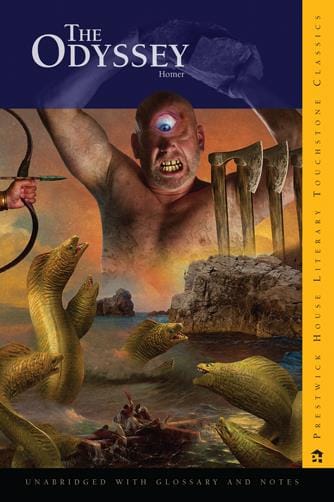
The Odyssey
Our Literary Touchstone Classics are unabridged, complete texts, and come with unbelievable prices. Each book is a value-priced, high-quality trade paperback, which you will receive for at least 50% off retail.
Summary of The Odyssey
Key Facts
- Publication Date: 2006 (Literary Touchstone Classics edition), 1898 translation by Samuel Butler
- Length: 278 pages
- Recommended Grade Band: 9-10
The Odyssey chronicles the long-winded epic journey of war hero Odysseus, who is returning home after the Trojan War. Unfortunately for Odysseus (but perhaps fortunately for reader entertainment purposes), he runs into abundant obstacles, including imprisonment, death-defying storms, Cyclopes, drugs, Sirens, and threats of the Underworld. He eventually returns home, in disguise, to win back his wife Penelope.
Content Warning: The Odyssey contains some sexual content.
What Your Students Will Love About The Odyssey
- The epic thrills and adventures
- Odysseus’s comparability to modern literary heroes
Potential Student Struggles With The Odyssey
- Boy, is it a dense text!
- The old English translation
Learning Objectives for The Odyssey
- Explain how The Odyssey fits the definition of an epic poem and how Odysseus can be characterized as an epic hero.
- Diagram the plot of The Odyssey in the context of 17 Stages of Cambell’s Monomyth.
- Identify the four major conflicts (man vs. man, man vs. nature, man vs. self, man vs. society) throughout the text.
- Understand the symbolic significance of the sea, Laertes’s shroud, Odysseus’s bow, and Odysseus’s home.
- Compare the roles and values of epic heroes to those of modern heroes.
- Differentiate between static and dynamic characters.
- Discuss oral tradition, specifically why ancient civilians repeated stories.
Literary Elements in The Odyssey
- Allusion
- Anthromorphism
- Conflict
- Deus ex machina
- Epix simile
- Epithet
- Foreshadowing
- In medias res
- Omen
- Symbolism
- And more!
Major Themes in The Odyssey
Hospitality — Xenia, the Ancient Greek term for the guest-host relationship, is a keystone in this society. The Odyssey offers examples of both good and pretty terrible hospitality.
Related Works:
- Who’s Afraid of Virginia Woolf?, by Edward Albee
- The Iliad, by Homer
- Beowulf, translated by Burton Raffel
Loyalty — Various characters in the text demonstrate that loyalty holds great significance in this ancient society, and that disloyalty yields grave consequences.
Related Works:
- Julius Caesar, by William Shakespeare
- King Lear, by William Shakespeare
- A Doll's House, by Henrik Ibsen
Vengeance — Poseidon seeks revenge by punishing Odysseus for blinding the Cyclops, Poseidon’s son.
Related Works:
- Frankenstein, by Mary Shelley
- The Count of Monte Cristo, by Alexandre Dumas
- Wuthering Heights, by Emily Brontë
Other Resources for The Odyssey
- NBC released The Odyssey miniseries in 1997. This two-part, made-for-TV movie was written and directed by Andrei Konchalavsky, who won an Emmy for his work. It features exciting special effects and some scenes that are accurate to the original text, but for the most part it is an unreliable adaptation. Check out the trailer. (Watch the trailer)
- “How 6 Popular Movies Follow the Hero’s Journey”
- “All-Nighter With the Odyssey”
- “The First Woman to Translate the ‘Odyssey’ into English”
- Map of Odysseus's journey
- CPALMS lesson plan comparing The Odyssey to Wreck-it Ralph
Order The Odyssey Resources from Prestwick House
| Resource | Format |
|---|---|
| The Odyssey Paperback | Student Edition |
| The Odyssey Teaching Unit | Reproducible Downloadable 30-Book Set |
| The Odyssey AP Teaching Unit | Reproducible Downloadable 30-Book Set |
| The Odyssey Activity Pack | Reproducible Downloadable 30-Book Set |
| The Odyssey Response Journal | Reproducible Downloadable 30-Book Set |
| The Odyssey Complete Teacher's Kit | Reproducible Downloadable 30-Book Set |