How to Teach The Metamorphosis
It won’t be difficult for The Metamorphosis to capture students’ interest; after all, the main character wakes up one morning transformed into a bug.

It won’t be too difficult for The Metamorphosis to capture students’ interest; after all, the main character of the novella, Gregor, casually wakes up one morning transformed into a bug. Why? The reader never finds out, and it is exactly this vagueness and intrigue that makes Franz Kafka’s story so perfect to dissect in a classroom.
Most critics and educational professionals alike will agree that The Metamorphosis is an allegory, so instructing students on symbolism, foreshadowing, irony, and humor is a must. Exactly what the story represents, however, is wide open for interpretation, so be sure to explore all possibilities through class discussion. Three of the numerous theories are:
The novella is autobiographical and expresses the isolation Kafka felt as a both German in Czech Prague and Jewish during a particularly anti-Semitic time. He also had a difficult relationship with his father, which could have contributed to Mr. Samsa’s characterization.
Gregor’s experiences mirror that of the Jewish diaspora in general.
The events of the novel are meant to evoke questions about human decency (what qualifies as human? What qualifies as decent?).
Your students will likely want to understand why and how Gregor turns into a bug, but steer their attention toward the more answerable questions: How does Gregor’s family change, and what does their transformation represent? What does Gregor’s eerily calm reaction to his metamorphosis suggest about existentialism (a philosophy that became popular in the 19th century and was quite influential on Kafka’s writing)?
Below, find out more information on teaching The Metamorphosis.
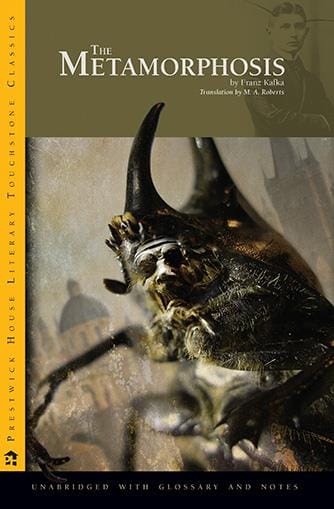
The Metamorphosis
Our Literary Touchstone Classics are unabridged, complete texts, and come with unbelievable prices. Each book is a value-priced, high-quality trade paperback, which you will receive for at least 50% off retail.
Summary of The Metamorphosis
Key Facts
- Publication Date: 1915; 2005 (Literary Touchstone Classics edition)
- Length: 80 pages; 2006 (Literary Touchstone Classics edition)
- Lexile Measure: 1340
- Recommended Grade Band: 11-12
One seemingly typical morning, traveling salesman Gregor Samsa oversleeps and is late for work, alarming his family. Is he ill? Hurt? No—he has inexplicably transformed into a grotesque, human-sized insect. The novella traces Gregor’s internal thoughts as he becomes familiar with his new form; it also explores how this metamorphosis affects his parents and sister.
Content Warning: The Metamorphosis contains an incident of death.
What Your Students Will Love About The Metamorphosis
- The enjoyably absurd plot
- The amount of analyzable material packed into the short novella
Potential Student Struggles With The Metamorphosis
- The lack of explanation for Gregor’s transformation
- Large blocks of text without dialogue breaks
Learning Objectives for The Metamorphosis
- Trace the change experienced by Gregor’s family members.
- Draw conclusions regarding Kafka’s view of both totalitarianism and capitalism.
- Support or refute the opinion that The Metamorphosis is a “timeless” story.
- Note the significance of recurring pairs of three in the novella.
- Understand the features of an existential viewpoint.
Literary Elements in The Metamorphosis
- Allegory
- Existentialism
- Foreshadowing
- Irony
- Persona
- Symbolism
- Theme
- Verisimilitude
- And more!
Major Themes in The Metamorphosis
Isolation — The novella explores the experience of “the other” through insect-Gregor’s isolation from his family and the world at large.
Related Works:
- Invisible Man, by Ralph Ellison
- Into the Wild, by Jon Krakauer
- Jane Eyre, by Charlotte Brontë
Transformation — Putting aside the obvious bug transformation, consider that Gregor’s family members must adapt to life without Gregor’s earnings, and their roles and mindsets shift drastically.
Related Works:
- A Lesson Before Dying, by Ernest Gaines
- Orphan Train, by Christina Baker Kline
- The Odyssey, by Homer
Existentialism — Kafka employs the idea that humans are directly responsible for their own development through conscious acts.
Related Works:
- The Stranger, by Albert Camus
- No Exit and Three Other Plays, by Jean-Paul Sartre
- Rosencrantz and Guildenstern Are Dead, by Tom Stoppard
Other Resources for The Metamorphosis
- A film version of The Metamorphosis, adapted and directed by Chris Swanton, debuted in 2012 at the Montreal World Film Festival. According to The Hollywood Reporter, the film is “quite faithful to the book” but is “unlikely to satisfy Kafka fans.” The CGI giant bug turned out to look rather silly, apparently. (Watch trailer)
- The Goethe Institute in Prague has adapted The Metamorphosis into a VR game in which the player “step[s] into the shoes of the protagonist.”
- Ted-Ed: What makes something Kafka-esque?
- Clip from The Metamorphosis stage production at the Royal Opera House
- On Translating Kafka's The Metamorphosis
- Activities to Teach The Metamorphosis by Franz Kafka
Order The Metamorphosis Resources from Prestwick House
| Resource | Format |
|---|---|
| The Metamorphosis Paperback | Student Edition |
| The Metamorphosis Complete Teacher's Kit | Reproducible Downloadable |
| The Metamorphosis Teaching Unit | Reproducible Downloadable 30-Book Set |
| The Metamorphosis AP Teaching Unit | Reproducible Downloadable 30-Book Set |
| The Metamorphosis Activity Pack | Reproducible Downloadable 30-Book Set |
| The Metamorphosis Response Journal | Reproducible Downloadable 30-Book Set |
| The Metamorphosis Multiple Critical Perspectives | Reproducible Downloadable 30-Book Set |
This free guide was originally posted in June 2016. It has been updated as of September 2019.