
How to Teach The Hunger Games
Discover what makes The Hunger Games the perfect introduction to dystopian fiction.

An exciting read, The Hunger Games is the perfect book to introduce students to dystopian fiction. Suzanne Collins’s novel explores an oppressive regime, poverty, social division, and violence as entertainment. These themes allow for class discussion of how Collins’s work comments on modern society in regards to government surveillance, social class, war, and the popularity (and controversy) of reality TV shows. Collins was also inspired by ancient Roman gladiatorial games and the Greek myth of Theseus and the Minotaur, so students should be familiar with these subjects and how they relate to the novel’s plot.
When teaching this book, you might consider emphasizing its point of view and tense. It is told in the present tense from Katniss’s first-person perspective. The class can discuss how this narrative form affects the pacing of the plot in terms of action and Katniss’s knowledge of what is happening. Students can also consider how the emotional impact of the novel would be altered if the narrative form were different—how alternate perspectives could manipulate audience perception of the text.
Below, get the facts on teaching The Hunger Games!
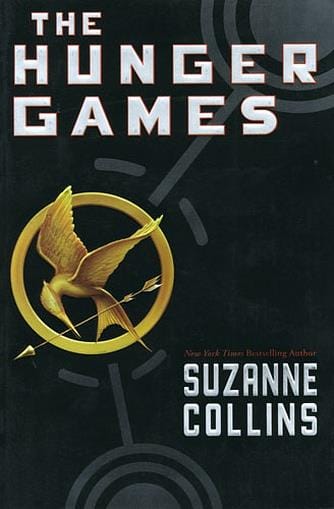
The Hunger Games
You'll always save at least 25% on any paperback you order. If the retail value of your order is at least $500, you'll save 30%. And if the retail value of your order is at least $2,500, you'll save 35% on all your paperbacks.
Summary of The Hunger Games
Key Facts
- Publication Date: 2008
- Length: 384 pages
- Lexile Measure: 810
- Recommended Grade Band: 6-8
The Hunger Games is set in Panem, a dystopian nation established in North America after an unspecified apocalyptic event. In order to punish the twelve districts for a past rebellion, the wealthy Capitol of Panem has created the Hunger Games, an event in which twenty-four adolescent boys and girls are selected as tributes and must fight to the death until only one remains.
Sixteen-year-old Katniss Everdeen volunteers to participate in the Games in place of her younger sister. She and Peeta Mellark, the other tribute from her district, try to survive as Panem watches their star-crossed romance unfold in the televised arena.
Content Warning: The Hunger Games contains violence and some sexual content.
What Your Students Will Love About The Hunger Games
- Katniss as a dependable and strong female protagonist
- The swift flow of action throughout the novel, especially when in the arena
- Watching the relationship between Katniss and Peeta unfold, especially when they must use that relationship to survive
Potential Student Struggles With The Hunger Games
- The violence depicted in the novel
- Limited introspection from the characters
Learning Objectives for The Hunger Games
- Recognize the first-person form of narration and comment on why Collins may have chosen this particular type of narration.
- Discuss the tyrannical nature of the government of Panem and describe the various tactics the Capitol uses to maintain its power.
- Identify references to ancient Rome, pointing out how the Hunger Games are analogous to the gladiatorial games.
- Trace the evolution of the “star-crossed lovers” scenario between Katniss and Peeta.
- Evaluate the extent to which Katniss and Peeta remain true to their identities before, during, and after the Games.
- Expand upon the concepts of manipulation, deception, and appearance versus reality as they relate to both the Games and today’s reality TV shows.
- Pinpoint and analyze symbols used throughout the novel.
Literary Elements in The Hunger Games
- Allusion
- Dystopia
- Flashback
- Foreshadowing
- Imagery
- Irony
- Metaphor
- Personification
- Symbolism
- And more!
Major Themes in The Hunger Games
Oppression — The government of Panem oppresses the districts by keeping them divided and alienated from one another, and, although most people silently endure, there is an undercurrent of rebellion.
Related Works:
- The Giver, by Lois Lowry
- Among the Hidden, by Margaret Peterson Haddix
- The Marrow Thieves, by Cherie Dimaline
Death — How each character reacts to death is significant; some view it as entertainment, while others try to maintain the dignity of the deceased.
Related Works:
- Scythe, by Neal Shusterman
- A Monster Calls, by Patrick Ness and Siobhan Dowd
- We Are Okay, by Nina LaCour
Survival — When in the arena, the characters fight to survive without losing parts of themselves in the process.
Related Works:
- The Book Thief, by Markus Zusak
- Life of Pi, by Yann Martel
- The Call of the Wild, by Jack London
Other Resources for The Hunger Games
- The Hunger Games movie was released in 2012. The medium of film cannot convey Katniss’s first-person point of view, but the movie stays fairly true to the book. The main change in the movie is how Katniss acquires the mockingjay pin, which causes the pin to lose some of its symbolic significance. (Watch the trailer)
- Scholastic Q&A with Suzanne Collins
- Suzanne Collins’s War Stories for Kids
- The Political Message of The Hunger Games
- Top 7 Tips for Teaching The Hunger Games
Order The Hunger Games Resources from Prestwick House
| Resource | Format |
|---|---|
| The Hunger Games Paperback | Student Edition |
| The Hunger Games Teaching Unit | Reproducible Downloadable 30-Book Set |
This free guide was originally posted in May 2018. It has been updated as of October 2019.