

How to Teach Speak
Laurie Halse Anderson’s story of isolation, grief, and hope provides lessons on symbolism and character development.

Speak is a compelling, oftentimes brutal coming-of-age story about Melinda, a high school freshman. The novel deals with sensitive subjects like rape and depression while allowing students to relate to and empathize with the narrator and discuss these topics in a constructive and safe setting. Before teaching the specifics of the novel, you might consider facilitating an open conversation on sexual assault, consent, rape culture, and explain how to both seek and offer support. It may also be useful for students to journal their thoughts and reactions, either while reading or upon completion of the book. They will likely have much to say.
This novel depicts high school cliques and the damaging effects of bullying and isolation. Students will not only analyze how these social dynamics play into Melinda’s deterioration, but also recognize their own experiences or at least those of a loved one. Bullying remains an epidemic in schools, and Speak is a reminder to support one another and treat one another kindly.
Speak has literary importance, too. Anderson uses symbolism to represent Melinda’s trauma and recovery. Students can discuss the significance of trees, the closet, and Melinda’s art. Infusing art into lessons on symbolism and emotional therapy would engage students who are more visual or hands-on learners. Anderson also uses intertextuality and references The Scarlet Letter, Maya Angelou’s writing, and classic fairy tales. Students should be familiarized with these works and authors so that they understand why and how these allusions maintain Speak’s themes.
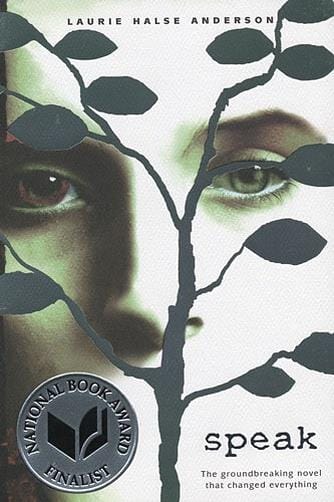
Speak
You'll always save at least 25% on any paperback you order. If the retail value of your order is at least $500, you'll save 30%. And if the retail value of your order is at least $2,500, you'll save 35% on all your paperbacks.
Summary of Speak
Key Facts
- Publication Date: 1999
- Length: 208 pages
- Lexile Measure: 690
- Recommended Grade Band: 9-10
- New York Times Bestseller; 1999 National Book Award Finalist; 1999 BCCB Blue Ribbon Book; 2000 ALA Best Books for Young Adults; 2000 Printz Honor Book
After calling the police and getting the senior party broken up at the end of summer, Melinda Sordino is ostracized by her peers. She refuses to explain why she called the authorities and becomes severely depressed, barely speaking at all. When Melinda admits to herself that senior Andy Evans raped her at the party, she slowly begins to heal and communicate her emotions through art. After she is forced to confront Andy to protect herself and her friend, other girls at the school reveal that they, too, have silently suffered Andy’s attacks. At the end of the school year, Melinda completes her art project and tells her art teacher, Mr. Freeman, what happened to her.
Content Warning: Speak contains underage drinking, bullying, self-mutilation, and sexual assault.
What Your Students Will Love About Speak
- Melinda’s sarcastic thoughts about school, her teachers, and her classmates.
- The many images and metaphors that Anderson creates throughout the novel.
Potential Student Struggles With Speak
- The sensitive subjects of the novel. Some students may be triggered by the traumatic events presented in the text, and it is important to provide substantial warnings and a safe space for these students.
Learning Objectives for Speak
- Trace Melinda’s personal growth over the course of the novel.
- Identify and discuss Anderson’s use of sensory images and how they relate to Melinda’s emotions.
- Understand the use of tone in key scenes.
- Discuss how this is a coming-of-age novel for Melinda.
- Identify the antagonist(s) throughout the novel.
- Evaluate the effectiveness of the title and discuss the irony of the word Speak as it relates to the book.
Literary Elements in Speak
- Allusion
- Antithesis
- Flashback
- Foreshadowing
- Imagery
- Inference
- Irony
- Metaphor
- Simile
- Symbol
- And more!
Major Themes in Speak
Isolation — One of the main themes in the novel involves Melinda’s silence and her inability to talk to others about what happened to her.
Related Works:
- The Sun Also Rises, by Ernest Hemingway
- One Hundred Years of Solitude by Gabriel Garcia Marquez
- Waiting for Godot by Samuel Beckett
Grief — This novel exemplifies the immobility that derives from grief and depicts the true dangers of depression.
Related Works:
- The Lovely Bones, by Alice Sebold
- Out of the Dust, by Karen Hesse
- Wintergirls, by Laurie Halse Anderson
Hope — It is relieving to see Melinda finally tell someone about her attack and undergo a transformation from the sullen, quiet girl she was at the beginning, to a person with a renewed sense of self.
Related Works:
- The Five People You Meet in Heaven, by Mitch Albom
- The Miracle Worker, by William Gibson
- Sold, by Patricia McCormick
Other Resources for Speak
- An independent film adaptation of Speak was released in 2004 and premiered at the Sundance Film Festival. It is now available on DVD. Check out the trailer!
- Video: Laurie Halse Anderson discusses Speak
- Speak turns 15
- Speak Classroom Guides and Resources
- Speak Discussion Questions from Macmillan
Order Speak Resources from Prestwick House
| Resource | Format |
|---|---|
| Speak Paperback | Student Edition |
| Speak Complete Teacher's Kit | Reproducible Downloadable 30-Book Set |
| Speak Teaching Unit | Reproducible Downloadable 30-Book Set |
| Speak Activity Pack | Reproducible Downloadable 30-Book Set |
| Speak Response Journal | Reproducible Downloadable 30-Book Set |