How to Teach Pride and Prejudice
Learn all about teaching Jane Austen’s Pride and Prejudice with our free guide.

One of the most popular books in English literature, Jane Austen's Pride and Prejudice follows the story of Elizabeth Bennet, a witty and outspoken woman, as she moves through high society in 19th century England.
Pride and Prejudice uses satire and irony to critique England’s Regency Era. Defining these two literary techniques and examining their use throughout the novel will help students understand Austen's critiques on the treatment of women and the social hierarchy of the Regency Era.
An overview of the Regency Era will provide students with the necessary historical context. Having students create charts to examine the relationships between characters as well as their respective places in the hierarchy will help students further understand the class system, an important aspect of this novel, as it is a source of "pride and prejudice."
Taking a look at the many adaptions of the novel in the forms of both books and movies will both engage students and allow the opportunity for comparisons. This beloved classic has been transformed time and time again, each adaptation giving it new life. While students may not be able to relate to the 19th-century troubles of Elizabeth Bennet, modern adaptations such as Bridget Jones's Diary or the YouTube vlog series The Lizzie Bennet Diaries may help students grasp the important concepts.
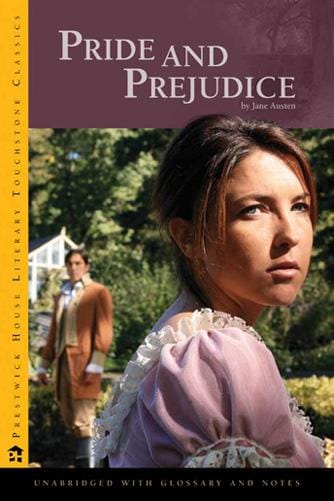
Pride and Prejudice
Our Literary Touchstone Classics are unabridged, complete texts, and come with unbelievable prices. Each book is a value-priced, high-quality trade paperback, which you will receive for at least 50% off retail.
Summary of Pride and Prejudice
Key Facts
- Publication Date: 1813
- Length: 336 pages
- Lexile Measure: 1190
- Recommended Grade Band: 11-12
Pride and Prejudice explores the lives of Elizabeth Bennet and her sisters as their mother attempts to find a suitable husband for each of them. Despite the typical conventions of marrying for financial security and status, Elizabeth wishes to marry for love. The story unfolds as she meets Mr. Fitzwilliam Darcy, a wealthy member of the upper class, at a ball. After meeting, it seems clear that Darcy is not interested in Elizabeth due to her social status, and, in turn, Elizabeth finds him to be condescending and full of pride.
As they often find themselves in each other's company, Darcy begins to soften towards Elizabeth as she learns more about him. Both must overcome their pride and prejudice in order to reveal their true feelings towards one another.
What Your Students Will Love About Pride and Prejudice
- The author's use of satire and irony
- The strong female protagonist
Potential Student Struggles With Pride and Prejudice
- The 19th-century language
- The limited action and focus on romantic drama
Learning Objectives for Pride and Prejudice
- Define irony and point out examples of it in the text.
- Cite incidents from the story that demonstrate the relationship between the position enjoyed and the responsibilities held by the upper class.
- Compare and contrast Mr. Darcy and Mr. Collins, and discuss the extent to which each realizes his plans for marriage.
- Discuss which qualities in Jane Austen's novels have led critics to regard her as one of the best writers of English literature.
- Comment on the author's style of writing, and illustrate points with examples from the text.
- Determine and discuss the reasons some readers view this novel as an early feminist work.
Literary Elements in Pride and Prejudice
- Hyperbole
- Inference
- Irony
- Satire
- Style
- Theme
- And more!
Major Themes in Pride and Prejudice
Social Class — During the 19th century, one's rank in the social hierarchy determined everything. Many of the characters in this novel are very concerned with maintaining their status. For Mr. Darcy, these ranks are strict—he refuses to acknowledge anyone below his class. It is through her depictions of the wealthy, pretentious characters that Austen critiques the class system.
Related Works:
- Jane Eyre, by Charlotte Brontë
- Wuthering Heights, by Emily Brontë
- Pygmalion, by George Bernard Shaw
Women and Femininity — Throughout the novel, Austen is critical of the role of women in 19th-century English society, focusing particularly on marriage. For most women, financial security is the most important motivation for marriage in order to maintain a high social standing. Elizabeth defies this convention by marrying for love.
Related Works:
- Sense and Sensibility, by Jane Austen
- A Doll's House, by Henrik Ibsen
- Tess of the d'Urbervilles, by Thomas Hardy
Pride — Pride initially prevents Mr. Darcy and Elizabeth from realizing their true feelings for each other. Mr. Darcy's pride in his social rank leads him to dismiss anyone below him. Elizabeth's pride in her ability to judge the character of others prevents her from changing her initial opinion of Darcy.
Related Works:
- Animal Farm, by George Orwell
- A Raisin in the Sun, by Lorraine Hansberry
- The Iliad, by Homer
Other Resources for Pride and Prejudice
- There have been multiple film productions of Pride and Prejudice, and the following are the most notable:
- Robert Z. Leonard's 1940 adaptation starring Laurence Olivier and Greer Garson
- The 1995 BBC TV miniseries starring Colin Firth and Jennifer Ehle
- Joe Wright's 2005 adaptation starring Keira Knightly and Matthew MacFadyen
- The Lizzie Bennet Diaries on YouTube
- Pride and Prejudice has also inspired other adaptations including:
- Bridget Jones's Diary, starring Renée Zellweger, Hugh Grant, and Colin Firth
- Pride and Prejudice and Zombies, starring Lily James and Sam Riley
- Status, Rank, and Class in Jane Austen's Novels
- The Influence of Jane Austen's Social Background on Two of Her Novels
- Historical Context for Pride and Prejudice
- Jane Austen and Social Judgment
- Teacher/Student Guides from Jane Austen's World
Order Pride and Prejudice Resources from Prestwick House
| Resource | Format |
|---|---|
| Pride and Prejudice Paperback | Student Edition |
| Pride and Prejudice Teaching Unit | Reproducible Downloadable 30-Book Set |
| Pride and Prejudice AP Teaching Unit | Reproducible Downloadable 30-Book Set |
| Pride and Prejudice Activity Pack | Reproducible Downloadable 30-Book Set |
| Pride and Prejudice Response Journal | Reproducible Downloadable 30-Book Set |
| Pride and Prejudice Multiple Critical Perspectives | Reproducible Downloadable 30-Book Set |
| Pride and Prejudice Complete Teacher's Kit | Reproducible Downloadable 30-Book Set |
This free guide was originally posted in July 2016. It has been updated as of October 2020.