How to Teach Othello
The jealousy, betrayal, and manipulation in Shakespeare’s Othello make the play an excellent addition to any high school syllabus.

One of Shakespeare's most thrilling plays, Othello is a timeless story of jealousy, romance, and revenge. Like his other tragedies, Othello follows Shakespeare's five-act structure in which each act highlights a specific action: exposition, rising action, climax, falling action, and resolution. As your students read Othello, consider having them map out events in each act that correspond with each plot element.
In addition, Othello contains another of Shakespeare's favorite dramatic elements: the tragic hero. Students can trace the evolution of Othello as a tragic hero over the course of the play, identifying instances in which the character exemplifies those traits. What is Othello's tragic flaw that causes his downfall?
In order to get the most out of Othello, students should understand the play's cultural context, especially its historic Venetian setting. Because of its location along the Mediterranean trade route, Renaissance-era Venice attracted people from a variety of ethnic and cultural backgrounds. However, Venice's original inhabitants considered many of these people outsiders. A background lesson about historic Venetian society may help students better understand the reasons certain characters treat Othello with disdain.
Readers should also recognize Othello's groundbreaking status in Western literature as one of the earliest plays to address racism and feature a black protagonist. Through Othello, students can witness and examine the effects of racism, specifically isolation and stereotyping, on a person. With the case of the titular character in mind, do stereotypes tend to yield self-fulfilling prophecies? Class discussion may extend to other related topics as well, including gender discrimination, as seen in the treatment of Desdemona and Emilia.
Learn everything you need to know about teaching Othello below!

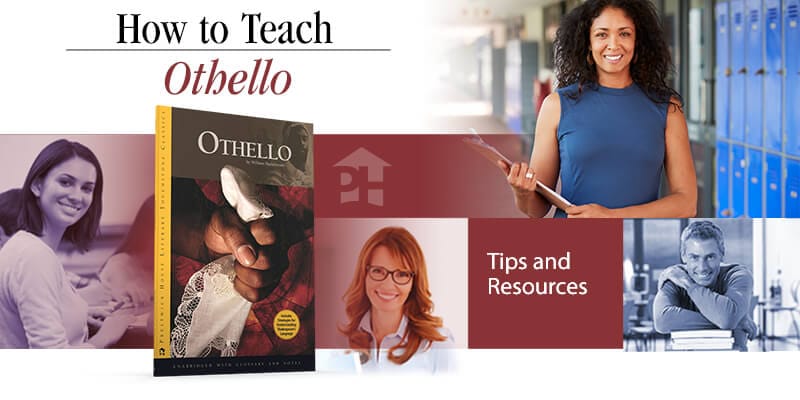
Othello
Our Literary Touchstone Classics are unabridged, complete texts, and come with unbelievable prices. Each book is a value-priced, high-quality trade paperback, which you will receive for at least 50% off retail.
Summary of Othello
Key Facts
- Publication Date: 1603; 2005 (Literary Touchstone Classics edition)
- Length: 128 pages (Literary Touchstone Classics edition)
- Recommended Grade Band: 11-12
After he is passed over for a promotion to lieutenant, the jealous Iago seeks revenge on those who have wronged him. With the help of a lovelorn Roderigo, he is able to manipulate the lives and minds of Othello, Cassio, and Desdemona as his plan comes to fruition. Lovers are betrayed and friends are manipulated in this Shakespearean tragedy.
Content Warning: Othello contains violence and sexual themes.
What Your Students Will Love About Othello
- The action of the plot
- Witnessing Iago's complex plan for revenge unfold
Potential Student Struggles With Othello
- Deciphering Shakespeare's language
- Keeping track of all the characters and their relationship to one another
Learning Objectives for Othello
- Define tragic hero and identify which character in Othello fits this role.
- Point out instances of the conflict between what appears to be and what actually is.
- Identify allusions to Greek and Roman mythology and to the Bible throughout the play.
- Trace Shakespeare’s use of animal imagery to symbolize characters and their actions.
- Compare and contrast the two female characters, Desdemona and Emilia.
- Analyze the effect of dramatic irony and foreshadowing on the development of the plot.
Literary Elements in Othello
- Allusion
- Aside
- Climax
- Dramatic irony
- Foreshadowing
- Inference
- Imagery
- Soliloquy
- Tragic hero
- And more!
Major Themes in Othello
Jealousy — Many of the characters in Othello are motivated by jealousy, especially Iago. Jealous of Cassio's promotion, Iago seeks revenge on the Othello and Cassio, destroying along the way the lives of those he involves in his scheme.
Related Works:
- The Crucible, by Arthur Miller
- A Separate Peace, by John Knowles
- Their Eyes Were Watching God, by Zora Neale Hurston
Prejudice — Othello is the target of racial prejudice throughout the play. As a Moor from North Africa, he is constantly described as a beast or animal and labeled as an outsider who is not deserving of respect.
Related Works:
- To Kill a Mockingbird, by Harper Lee
- The Color Purple, by Alice Walker
- Black Boy, by Richard Wright
Appearance vs. Reality — Iago seems straightforward and honest, but he actually uses the faith others have in him to create drama as he seeks his revenge.
Related Works:
- The Odyssey, by Homer
- Hamlet, by William Shakespeare
- The Glass Menagerie, by Tennessee Williams
Other Resources for Othello
- There have been many movie adaptations of Shakespeare's Othello, including the 1951 production directed by Orson Welles and Oliver Parker's 1995 film starring Lawrence Fishburne. (Watch trailer for the 1995 movie)
- Shakespeare's Othello and the Power of Language
- Modernizing Shakespeare: Finding Contemporary Themes in Othello
- Strangers in the City: The Cosmopolitan Nature of 16th-century Venice
- Creative Activities for Othello
- Shakespeare's Theater
Order Othello Resources from Prestwick House
| Resource | Format |
|---|---|
| Othello Paperback | Student Edition |
| Othello Teaching Unit | Reproducible Downloadable 30-Book Set |
| Othello AP Teaching Unit | Reproducible Downloadable 30-Book Set |
| Othello Activity Pack | Reproducible Downloadable 30-Book Set |
| Othello Response Journal | Reproducible Downloadable 30-Book Set |
| Othello Multiple Critical Perspectives | Reproducible Downloadable 30-Book Set |
| Othello Complete Teacher's Kit | Reproducible Downloadable 30-Book Set |