How to Teach Great Expectations
Great Expectations, Charles Dickens’s classic novel, conveys the journey of one ambitious orphan’s remarkable personal growth.

One of Charles Dickens’s most widely beloved novels, Great Expectations is considered a classic for many reasons. The timeless themes of social class, ambition, and growth provide plenty of opportunities for class discussion, and students will love the novel’s complex cast of characters.
Dickens originally published Great Expectations from 1860 to 1861 as a 36-part series in his magazine All the Year Round. Because he released the novel in installments, Dickens chose to employ several literary techniques to keep readers interested as the story unfolded. For this reason, Great Expectations is a rich resource for studying the effects of suspense and foreshadowing.
Furthermore, the novel actually has two different endings, depending on which version you read—the melancholic serialized ending, or the revision with a happier conclusion. These juxtaposing endings provide teachers with the opportunity to compare the two: Which ending is more realistic? Which best aligns with the novel’s universal ideas and supports Dickens’s main points about personal growth?
As a bildungsroman, Great Expectations follows its main character, Pip, as he transforms from a young boy into an accomplished adult. The reader witnesses Pip falling in love, feeling betrayal, and both gaining and losing fortune, all experiences that are universal to human nature and especially impactful in adolescence. Your students will undoubtedly connect to Pip’s journey and appreciate the depth in which Dickens delves into the struggle to not only achieve a dream, but to keep it alive.
Learn more about teaching Great Expectations below.
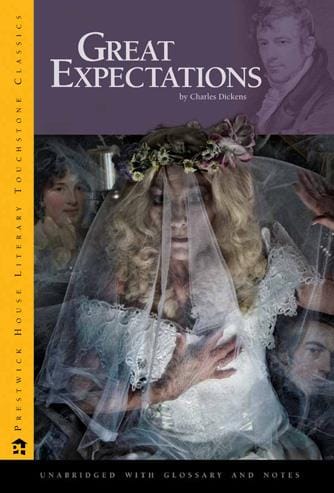
Great Expectations
Our Literary Touchstone Classics are unabridged, complete texts, and come with unbelievable prices. Each book is a value-priced, high-quality trade paperback, which you will receive for at least 50% off retail.
Summary of Great Expectations
Key Facts
- Publication Date: 1861; 2006 (Literary Touchstone Classics edition)
- Length: 472 pages (Literary Touchstone Classics edition)
- Lexile Measure: 1230
- Recommended Grade Band: 11-12
Great Expectations follows Pip, a poor orphan living with his sister and his brother-in-law in the English marshes, until he becomes an adult living in London. As a child, he falls in love with Estella, the cold but beautiful adopted daughter of his rich neighbor, Miss Havisham. These feelings launch his desire to become a “gentleman,” a dream that eventually comes to fruition once he receives funds from a mysterious benefactor. However, Pip learns many important lessons and faces consequences after his great expectations are met.
What Your Students Will Love About Great Expectations
- Following along with Pip’s life story
- The vibrant characters
Potential Student Struggles With Great Expectations
- Understanding the Victorian language
- The gloomy original ending
Learning Objectives for Great Expectations
- Define bildungsroman and trace Pip’s growth from poor orphan to gentleman.
- Discuss the role of each of the male influences in Pip’s life.
- Examine Dickens’s use of parallelism to develop the novel’s characters.
- Identify the ways in which Dickens uses light and darkness as symbols for good and evil.
- Examine the impact of first person narration on the story.
Literary Elements in Great Expectations
- Alternate ending
- Bildungsroman
- Dark humor
- Foreshadowing
- Imagery
- Metaphor
- Parallelism
- Personification
- Suspense
- Symbolism
- And more!
Major Themes in Great Expectations
Class — Pip’s journey conveys to the reader that social status is not connected to true character and that wealth and class are less important than inner worth.
Related Works:
- The Great Gatsby, by F. Scott Fitzgerald
- Pygmalion, by George Bernard Shaw
- Pride and Prejudice, by Jane Austen
Ambition — As its title indicates, Great Expectations emphasizes the possibility of advancement in life and explores one individual’s dedication to such a goal.
Related Works:
- Macbeth, by William Shakespeare
- The Prince, by Niccolo Machiavelli
- Narrative of the Life of Frederick Douglass, by Frederick Douglass
Crime — The novel raises this question about criminals: Are people born malevolent, or do they turn to crime as a result of misfortune and their upbringing?
Related Works:
- The Book Thief, by Markus Zusak
- Crime and Punishment, by Fyodor Dostoevsky
- Oliver Twist, by Charles Dickens
Other Resources for Great Expectations
- There have been numerous film adaptations of Great Expectations, but the most popular one is the 1946 version starring John Mills and Jean Simmons. The movie is a shortened version of the book, but still follows it closely. (Watch trailer)
- Charles Dickens’s Biography
- Dickens’s Great Expectations: Social Mobility Lesson
- Great Expectations Background Information
- An 1861 book review for Great Expectations
- Pip and Me: A Journey Into the World of Great Expectations
Order Great Expectations Resources from Prestwick House
| Resource | Format |
|---|---|
| Great Expectations Paperback | Student Edition |
| Great Expectations Teaching Unit | Reproducible Downloadable 30-Book Set |
| Great Expectations AP Teaching Unit | Reproducible Downloadable 30-Book Set |
| Great Expectations Activity Pack | Reproducible Downloadable 30-Book Set |
| Great Expectations Response Journal | Reproducible Downloadable 30-Book Set |
| Great Expectations Multiple Critical Perspectives | Reproducible Downloadable 30-Book Set |
| Great Expectations Complete Teacher's Kit | Reproducible Downloadable 30-Book Set |
This free guide was originally posted in October 2015. It has been updated as of July 2019.