

How to Teach Flowers for Algernon
Learn everything you need to know about teaching Flowers for Algernon, an award-winning science fiction novel by Daniel Keyes.

Originally published as a short story in 1959, Flowers for Algernon by Daniel Keyes is an award-winning science fiction novel that deftly explores the shifting nature of identity, the ethics of human experimentation, and society’s treatment of people with intellectual disabilities.
Because Flowers for Algernon was published in the mid-20th century, it contains outdated language used to describe intellectual disabilities. A brief lesson on the story’s historical context and the evolution of disability terminology may be appropriate before starting the book, as some students may find the obsolete terms to be offensive.
Flowers for Algernon is told through a series of progress reports written by the main character, Charlie. Through this epistolary format, readers receive a firsthand account of Charlie’s unfathomable rise—and rapid fall—in intelligence. Because the story is told completely from Charlie’s perspective, students should question Charlie’s reliability as a narrator. How do the changes in Charlie’s cognitive development impact his credibility when relaying events?
At the novel’s start, Daniel Keyes includes an epigraph quoting the philosopher Plato’s treatise, The Republic. In this excerpt, Plato discusses "The Allegory of the Cave," in which people are chained inside a dark cave and watch the shadows of real things projected on the cave walls. One man escapes and ventures into the light, where he comes to know reality. When he returns to share his experiences, the others don’t believe him. After finishing Flowers for Algernon, consider revisiting this epigraph with your students. What does the allegory tell us about perceived realities? In what ways does Charlie’s story parallel that of the man who escaped the cave?
Keep reading to learn more about teaching Flowers for Algernon!
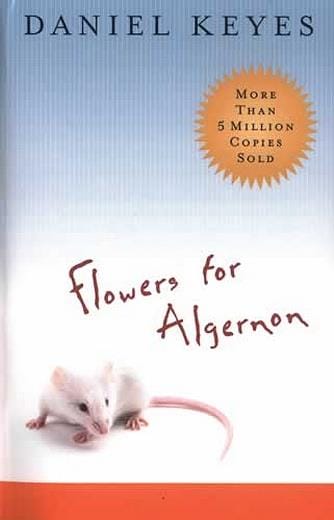
Flowers for Algernon
You'll always save at least 25% on any paperback you order. If the retail value of your order is at least $500, you'll save 30%. And if the retail value of your order is at least $2,500, you'll save 35% on all your paperbacks.
Summary of Flowers for Algernon
Key Facts
- Publication Date: 1966
- Length: 216 pages
- Lexile Measure: 910
- Recommended Grade Band: Lexile measure appropriate for grades 7-8, but content better suits this work for early high school
Charlie Gordon, a man with an intellectual disability, is chosen to undergo a scientific procedure designed to boost his IQ. The operation, which was previously performed successfully on a lab mouse named Algernon, causes Charlie’s intelligence to eventually surpass that of his doctors and his special needs teacher, Alice Kinnian.
With his increased cognitive abilities, Charlie starts to understand why people mistreated him before the operation and falls into depression. His emotions reach a breaking point when Algernon begins to show signs of cognitive decline. Knowing the effects of the experiment are only temporary, Charlie tries to reconcile with his estranged family and come to terms with his romantic feelings for Alice before his cognition regresses.
Content Warning: Flowers for Algernon contains mild language, sexual themes, and brief descriptions of child abuse.
What Your Students Will Love About Flowers for Algernon
- The immersive writing in the form of Charlie’s progress reports
- The fascinating science fiction elements
Potential Student Struggles With Flowers for Algernon
- The negative attitude and mistreatment toward people with intellectual disabilities
- The abuse Charlie experiences by his mother and sister
Learning Objectives for Flowers for Algernon
- Discuss the nature of intelligence—is it purely a scientific concept, or does it involve emotional depth as well?
- Analyze the ways in which intelligence can be alienating.
- Examine the use of flashbacks to illustrate Charlie’s character development.
- Trace the developing connection between Charlie and Algernon.
- Evaluate how Charlie’s style of writing changes as his intelligence both grows and diminishes.
Literary Elements in Flowers for Algernon
- Allusion
- Epigraph
- Flashback
- Foreshadowing
- Irony
- Metaphor
- Motif
- Symbolism
- Theme
- And more!
Major Themes in Flowers for Algernon
Isolation — While Charlie experiences heightened intelligence after having the operation, he finds himself isolated from others due to both his mental superiority and lack of emotional maturity.
Related Works:
- Of Mice and Men, by John Steinbeck
- To Kill a Mockingbird, by Harper Lee
- Speak, by Laurie Halse Anderson
Science — Flowers for Algernon explores the ethics surrounding human experimentation in the name of science. Was Charlie’s experience throughout the experiment justified for its potential scientific breakthroughs, or did he suffer needlessly?
Related Works:
- Ender's Game, by Orson Scott Card
- The Invisible Man, by H. G. Wells
- The Hitchhiker's Guide to the Galaxy, by Douglas Adams
Identity — After the operation, Charlie struggles to take ownership over his newer, smarter identity while grappling with his past self.
Related Works:
- Divergent, by Veronica Roth
- Dear Martin, by Nic Stone
- Adventures of Huckleberry Finn, by Mark Twain
Other Resources for Flowers for Algernon
- A movie adaptation of Flowers for Algernon debuted in 1968. Titled Charly, the film generally follows the main plot of the book, but omits several details, including Charlie’s relationship with Fay. (Watch film clip)
- Flowers for Algernon Rap by Jedd Bloom
- Daniel Keyes’s Biography
- "The Allegory of the Cave" by Plato
- “First Do (No) Harm”: Unethical Human Experimentation and Ethics
- The History of Stigmatizing Names for Intellectual Disabilities
Order Flowers for Algernon Resources from Prestwick House
| Resource | Format |
|---|---|
| Flowers for Algernon Paperback | Student Edition |
| Flowers for Algernon Teaching Unit | Reproducible Downloadable 30-Book Set |
| Flowers for Algernon AP Teaching Unit | Reproducible Downloadable 30-Book Set |
| Flowers for Algernon Activity Pack | Reproducible Downloadable 30-Book Set |
| Flowers for Algernon Response Journal | Reproducible Downloadable 30-Book Set |
| Flowers for Algernon Multiple Critical Perspectives | Reproducible Downloadable 30-Book Set |
| Flowers for Algernon Complete Teacher's Kit | Reproducible Downloadable 30-Book Set |