How to Teach Dracula
Bram Stoker’s famous work introduces students to Gothic fiction and the format of an epistolary novel.

Bram Stoker's Dracula is considered one of the most influential Gothic horror stories of all time. Since its publication, the novel has inspired countless adaptations and variations, each centering on the mysterious titular character. Before students begin reading the book, consider introducing them to the Gothic genre so they can identify the Gothic elements within the work.
An epistolary novel, Dracula is composed of journal entries, letters, and newspaper articles. Students should understand how this format offers different perspectives, adds suspense, and creates a greater degree of credibility.
Dracula is very much a story of its time. Historical background on the Victorian era and the spirit of fin de siècle, or end of the nineteenth century, will allow students to contextualize the work and will promote discussion on how the novel is a response to social and scientific changes. Stoker also relies heavily on Romanian folklore and history, so background on these subjects will be useful.
The novel can be analyzed by the dichotomies it portrays. The most obvious dichotomy is the fight between good and evil, but others include science and superstition, order and chaos, East and West, and virginal versus sexual women. Class discussion can involve how Stoker presents these dichotomies and how Dracula threatens Victorian England.
Keep reading to learn the dark secrets of teaching Dracula.
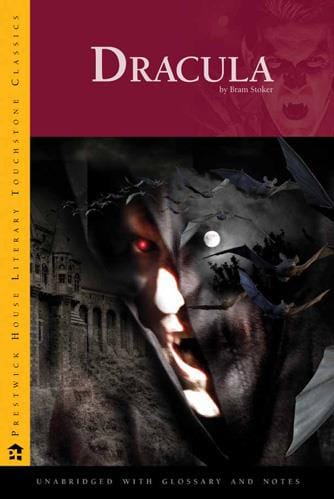
Dracula
Our Literary Touchstone Classics are unabridged, complete texts, and come with unbelievable prices. Each book is a value-priced, high-quality trade paperback, which you will receive for at least 50% off retail.
Summary of Dracula
Key Facts
- Publication Date: 1897; 2006 (Literary Touchstone Classics edition)
- Length: 368 pages (Literary Touchstone Classics edition)
- Lexile Measure: 1170
- Recommended Grade Band: 11-12
Jonathan Harker, an English lawyer, travels through Transylvania, Romania to conclude a real estate transaction with Count Dracula, but becomes a prisoner in Dracula's castle. Meanwhile, Harker's fiancée Mina visits her friend Lucy in Whitby, England, where a mysterious wrecked ship washes ashore. Lucy soon begins sleepwalking and falls ill. Professor Van Helsing, a friend of one of Lucy's suitors, determines that she is under the influence of a vampire. The protagonists then prepare to track down Dracula and stop his evil-doing.
Content Warning: Dracula contains some violence and sensuality.
What Your Students Will Love About Dracula
- Discovering the main inspiration for vampires in popular culture
- The suspenseful Gothic horror
Potential Student Struggles With Dracula
- The pacing and style of the epistolary format
- The advanced vocabulary
Learning Objectives for Dracula
- Recognize how the epistolary structure provides readers with several points of view, heightens suspense, and contributes to the novel's believability.
- Infer information about characters and events that is not explicitly stated.
- Cite incidents that illustrate that the novel is an example of Gothic fiction.
- Find passages in the story that illustrate Dracula's sensual qualities.
- Detail the extent of Dracula's powers and recognize his weaknesses; examine how Stoker incorporates these strengths and weaknesses into the story.
- Discuss the role superstition and folklore play in advancing the plot and in the defeat of Dracula.
Literary Elements in Dracula
- Allusion
- Epistolary Novel
- Foreshadowing
- Gothic Fiction
- Inference
- Irony
- Metaphor
- Personification
- Simile
- And more!
Major Themes in Dracula
Good vs. Evil — The protagonists, commonly referred to as the Crew of Light, represent the good of humanity as they battle Dracula's evil influence.
Related Works:
- Bless Me, Ultima, by Rudolfo Anaya
- The Ox-Bow Incident, by Walter Van Tilburg Clark
- Dr. Jekyll and Mr. Hyde, by Robert Louis Stevenson
Femininity — The novel looks at the idealized Victorian-era woman, the rise of female independence as women begin to enter the labor force, and the perceived threat of female sexuality.
Related Works:
- The Awakening, by Kate Chopin
- The Handmaid's Tale, by Margaret Atwood
- The Taming of the Shrew, by William Shakespeare
Redemption — The characters use Christian values and symbols to defeat Dracula, and once the un-dead are granted true deaths, their souls can be redeemed.
Related Works:
- Crime and Punishment, by Fyodor Dostoyevsky
- The Kite Runner, by Khaled Hosseini
- Dr. Faustus, by Christopher Marlowe
Other Resources for Dracula
- Dracula has been the basis for numerous films. The most well-known film adaptation is the 1931 black and white movie of the same name directed by Tod Browning and starring Bela Lugosi. It stays fairly true to the book and is appropriate for the classroom. (Watch trailer)
- Bram Stoker's Biography
- Roles of Women in the Victorian Era
- The Original Dracula Legend
- Watch: Key Motifs in Gothic Literature
- Vampire History and Folklore
- The Origins of the Gothic
Order Dracula Resources from Prestwick House
| Resource | Format |
|---|---|
| Dracula Paperback | Student Edition |
| Dracula Teaching Unit | Reproducible Downloadable 30-Book Set |
| Dracula Activity Pack | Reproducible Downloadable 30-Book Set |
| Dracula Response Journal | Reproducible Downloadable 30-Book Set |
| Dracula Complete Teacher's Kit | Reproducible Downloadable 30-Book Set |
This free guide was originally posted in June 2016. It has been updated as of September 2019.