How to Teach Beowulf
Beowulf is great material to use to examine the traits of heroes and monsters and introduce students to Old English works.

Often cited as one of the most important works of Old English literature, Beowulf is a great way to introduce students to epic poetry. There are many translations of Beowulf to choose from, including our Literary Touchstone Classics edition. Prose translations may work best if you have limited time, but more advanced high school students can study poetic translations, which will better demonstrate the meter of the original piece.
The original Beowulf manuscript is estimated to have been written between 975 and 1025 CE. Before starting Beowulf, you can show students how the English language has changed over the centuries by reading passages from Old, Middle, and early Modern English. In addition, a lesson on Germanic and Scandinavian history, Scandinavian legends, and Christian elements in Beowulf will help students contextualize the poem.
Your class can also discuss the definition of a hero or good leader versus that of a monster. They can relate these qualities to contemporary heroes, leaders, and “monsters.” This discussion will show students that, even though the culture in Beowulf seems far removed from modern times, the poem explores universal themes that are still relevant today.
Keep reading to learn more about this legendary story!
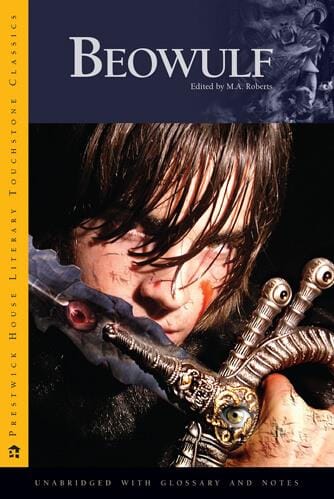
Beowulf
Our Literary Touchstone Classics are unabridged, complete texts, and come with unbelievable prices. Each book is a value-priced, high-quality trade paperback, which you will receive for at least 50% off retail.
Summary of Beowulf
Key Facts
- Publication Date: 2005 (Literary Touchstone Classics edition)
- Length: 112 pages (Literary Touchstone Classics edition)
- Recommended Grade Band: 11-12
Beowulf, a heroic warrior of the Geats, helps the Danish king Hrothgar, whose great hall is frequently attacked by a monster called Grendel. Beowulf slays Grendel with his bare hands, but the following night, Grendel’s mother seeks revenge. Hrothgar, Beowulf, and their men track Grendel’s mother to a pond, and Beowulf dives into the underwater lair and kills Grendel’s mother with a sword. The hero returns home and becomes king of the Geats.
Fifty years later, a dragon terrorizes the Geats. Beowulf tells his warriors that he must fight the beast alone. He defeats the monster but is mortally wounded in the process. The Geats hold a funeral and mourn him.
Content Warning: Beowulf contains violence.
What Your Students Will Love About Beowulf
- The adventure of Beowulf slaying monsters
- Exploring the elements of Germanic culture, Christianity, and Scandinavian legend
Potential Student Struggles With Beowulf
- Instances of plot digression highlighting other legendary figures
- The use of kennings to describe people, places, and things
Learning Objectives for Beowulf
- Recognize the elements of an epic poem in Beowulf.
- Identify characteristics of Germanic culture as depicted in Beowulf, including the commonality of feuds, the importance of weapons, and the attitudes toward life, death, and material possessions.
- Discuss the relevance of women’s roles in Germanic culture.
- Clarify the relevance of the anecdotes that interrupt the main story.
- Explain the Germanic heroic code and how its values differ between warrior and king.
- Identify the key characteristics that make Beowulf an epic hero.
Literary Elements in Beowulf
- Alliteration
- Anecdote
- Deus Ex Machina
- Foreshadowing
- Kenning
- Metaphor
- Symbolism
- And more!
Major Themes in Beowulf
Good vs. Evil — Beowulf features a battle between a courageous, loyal warrior and evil monsters that threaten the humans.
Related Works:
- Great Expectations, by Charles Dickens
- Dracula, by Bram Stoker
- Dr. Jekyll and Mr. Hyde, by Robert Louis Stevenson
Family and Community — In Beowulf, ancestry and tribal relations determine people’s identities; those without tribes are seen as incomplete.
Related Works:
- The Brief and Wondrous Life of Oscar Wao, by Junot Díaz
- Things Fall Apart, by Chinua Achebe
- Black Boy, by Richard Wright
Altruism vs. Egotism — Warriors and kings share values of loyalty, courage, and selflessness. However, a good king has a greater duty to his people, while warriors pursue personal glory.
Related Works:
- Mythology, by Edith Hamilton
- The Iliad, by Homer
- The Once and Future King, by T. H. White
Other Resources for Beowulf
- A number of films are based loosely on Beowulf. Perhaps the best-known film is the 2007 adaptation starring Ray Winstone, Anthony Hopkins, and Angelina Jolie. However, this movie deviates significantly from the original epic poem. (Watch trailer)
- The History Behind Beowulf
- Listen: Opening Lines of Beowulf In Old English
- Beowulf: Creative Assignments
- Beowulf at the Ancient History Encyclopedia
Order Beowulf Resources from Prestwick House
| Resource | Format |
|---|---|
| Beowulf Paperback | Student Edition |
| Beowulf Teaching Unit | Reproducible Downloadable 30-Book Set |
| Beowulf AP Teaching Unit | Reproducible Downloadable 30-Book Set |
| Beowulf Activity Pack | Reproducible Downloadable 30-Book Set |
| Beowulf Response Journal | Reproducible Downloadable 30-Book Set |
| Beowulf Multiple Critical Perspectives | Reproducible Downloadable 30-Book Set |
| Beowulf Complete Teacher's Kit | Reproducible Downloadable 30-Book Set |